
从供应链角度思考媒体企业
人工智能、云计算和自主学习技术将是以较低成本快速完成视频制作的发展基础
Media organizations must undergo a radical transformation if they wish to remain relevant, attract audiences and ultimately grow revenue.
The reasons are clear. Consumers have more video content choices than ever before, are using more platforms and devices to watch it on and are spending more time watching.
Consider a few facts and forecasts:
☐ 500 hours of video are uploaded to YouTube every minute—YouTube;
☐ 200 million households worldwide subscribed to at least one OTT service at the end of 2018, and 310 million are expected to by 2024—Parks Associates;
☐ 2.16 billion people watched video on their mobile phones in 2019, and 2.72 billion are expected to in 2023—eMarketer;
☐ 250 million hours of YouTube video are viewed daily on TV screens—YouTube.
For media companies with well-established workflows, quality benchmarks and cost structures, the urgent question demanding an answer is how to create far more content to compete for viewers, who have more alternatives, more screens and more services than ever, in a way that is economically feasible?
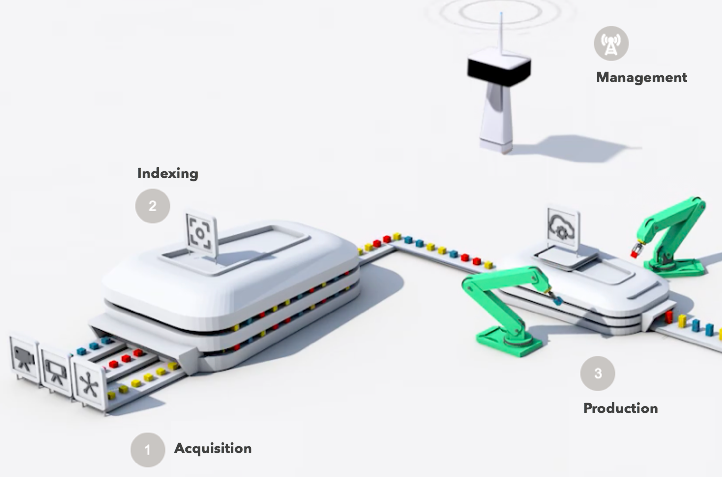
What’s needed is a rethinking of the entire media process –what rightly can be called the media supply chain. Not unlike other sectors of the economy, the media and entertainment industry has a supply chain of its own.
Rather than mining a mineral or harvesting a crop, the M&E industry supply chain starts with acquisition of video footage and audio. Keeping with the analogy, this raw material is transported and stored in a warehouse in the form of a Media Asset Management or Digital Asset Management system, moved to the assembly line of familiar post-production processes, such as editing, graphics and animation creation, audio mixing and color correction, and ultimately loaded on the equivalent of an 18-wheeler, in this case OTA broadcast, an OTT service, DVD or website, for distribution to consumers.
Each of those steps –acquisition and production, storage, post-production and distribution—has hard costs associated with it. Unfortunately, those costs are associated with a media supply chain that increasingly seems anachronistic.
What’s needed are approaches and technologies that help M&E companies radically transform the cost structure developed in a bygone era when there were far fewer competitors and media companies were generally fat and happy.
The first step will require M&E companies to re-examine their supply chains –not simply to identify places where costs can be cut but more importantly to unearth ways to derive far greater value from the “raw material” they acquire and bring into the “warehouse”.
Technologies, such as the cloud, artificial intelligence and machine learning, will prove to be catalysts for the transformation that is required to compete in today’s environment.
Over the coming months in this space, we will examine how M&E companies can leverage these and other technologies to improve their supply chains and unlock the unrealized value of raw video and audio assets that today are deleted and discarded and thus ultimately slash the average cost of an hour of finished, distributed video content.
Start a Discussion
For any information on this case or for any enquiries on the above products
We can help